
Meatballs, Smyrna Style
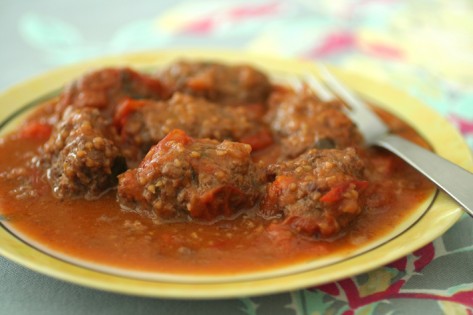
When I asked Georgia Cone, a Greek-American and member of the Dowdy Corners Cookbook Club, which of the recipes in The Food and Wine of Greece she recommended I try, Soutzoukakia Smyrneika, or Meatballs, Smyrna Style, was at the top of the list. Now that I’ve made them, I can understand why this dish is so popular among Greeks, despite the generous use of cumin—a spice that is lesser used or, in many regions in Greece, nonexistent.
After mixing ground beef with fresh parsley, cumin, garlic, onion, salt and pepper, and two tenderizing acids—bread soaked in red wine and red wine vinegar—the meatballs are formed into small oval nuggets and set in the fridge to rest for an hour. They are lightly browned in olive oil and simmered for an hour or so in a rich, roux-thickened sauce made with fresh tomatoes, red wine, and a very small amount of sugar.
The resulting meatballs are very tender and flavorful, and the naturally sweet and tangy tomato sauce, enriched with beef drippings, is addictive.
Diane Kochilas, the author of The Food and Wine of Greece, suggests serving the meatballs with rice or mashed potatoes. Trolling around the Internet for more information about these delicious meatballs, I found a reference to serving the meatballs with french fries on Peter Minakis’s blog Kalofagas: Greek Food and Beyond. He writes, “Think of the sauce as sweet, aromatic Greek ketchup . . . yummy sauce to mop up with the fries.” (This isn’t far off. I found a recipe for Greek ketchup on Food.com that is thickened with a roux and includes beef broth.)
The combination of french fries and luxuriously thick tomato “gravy” got me to thinking. Why not create a Greek spin on poutine—the popular Québécois dish of french fries, beef or chicken gravy, and cheese curds—swapping out the curds for feta? The photograph below this invention: oven-roasted fries topped with Smyrna-style meatballs and tomato sauce, feta, and some fresh chopped parsley for color.
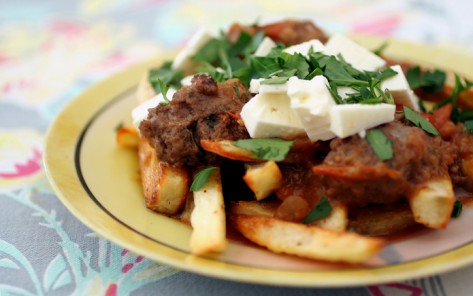
Whereas we enjoyed the meatballs served as a main course with mashed potatoes, and untraditionally as Greek poutine, our favorite way to eat them is the simplest: on their own as a meze offering with some good crusty bread to sop up the sauce. (Think of them as an alternative to the small Swedish meatballs popular as noshing or appetizer fare throughout America.)
You can find a recipe for Soutzoukakia Smyrneika on Diane Kochilas’s website.
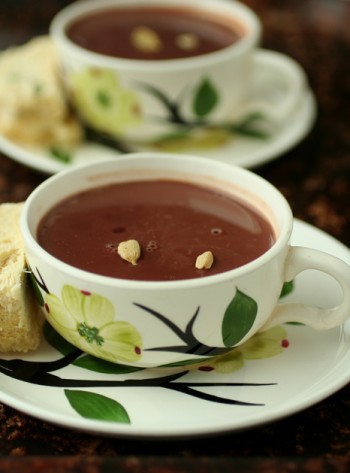
 Greeks love honey, and are famous for the variety and quality their bees produce, chief among being wild thyme honey. I’m intrigued with honeys that capture the flavor of specific regional herbs, flowers or trees, and, though I’ve never tried thyme honey, I like to imagine how it might taste. With this special Greek honey in mind, this drinking chocolate is sweetened with honey and infused with the flavor of fresh thyme and orange zest—the latter, a common ingredient in Greek pastries, cakes, biscuits, and breads. While I’m not sure how Greek this drinking chocolate tastes, it does taste good. I enjoyed it with Olive Oil Biscuits with Cumin and Sesame, a common breakfast food in Greece, from the DCCC pick The Food and Wine of Greece.* (For lots more information on the basics of making and serving drinking chocolate, read
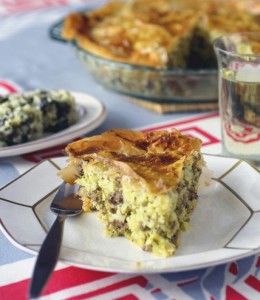
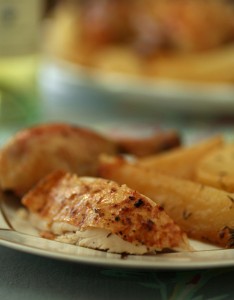
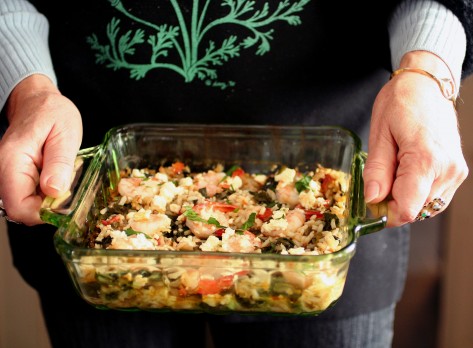 This is Georgia Cone’s family recipe for
 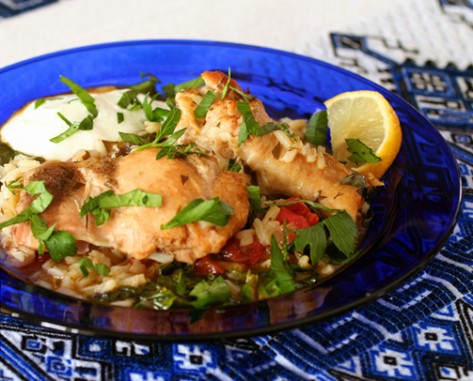 This is Georgia Cone’s family recipe for Spanakorizo me Kotopoulo, a hearty one-pot chicken-and-rice dish evolved from the simpler, vegetarian
 Loading ...