
Night at Mount Vernon
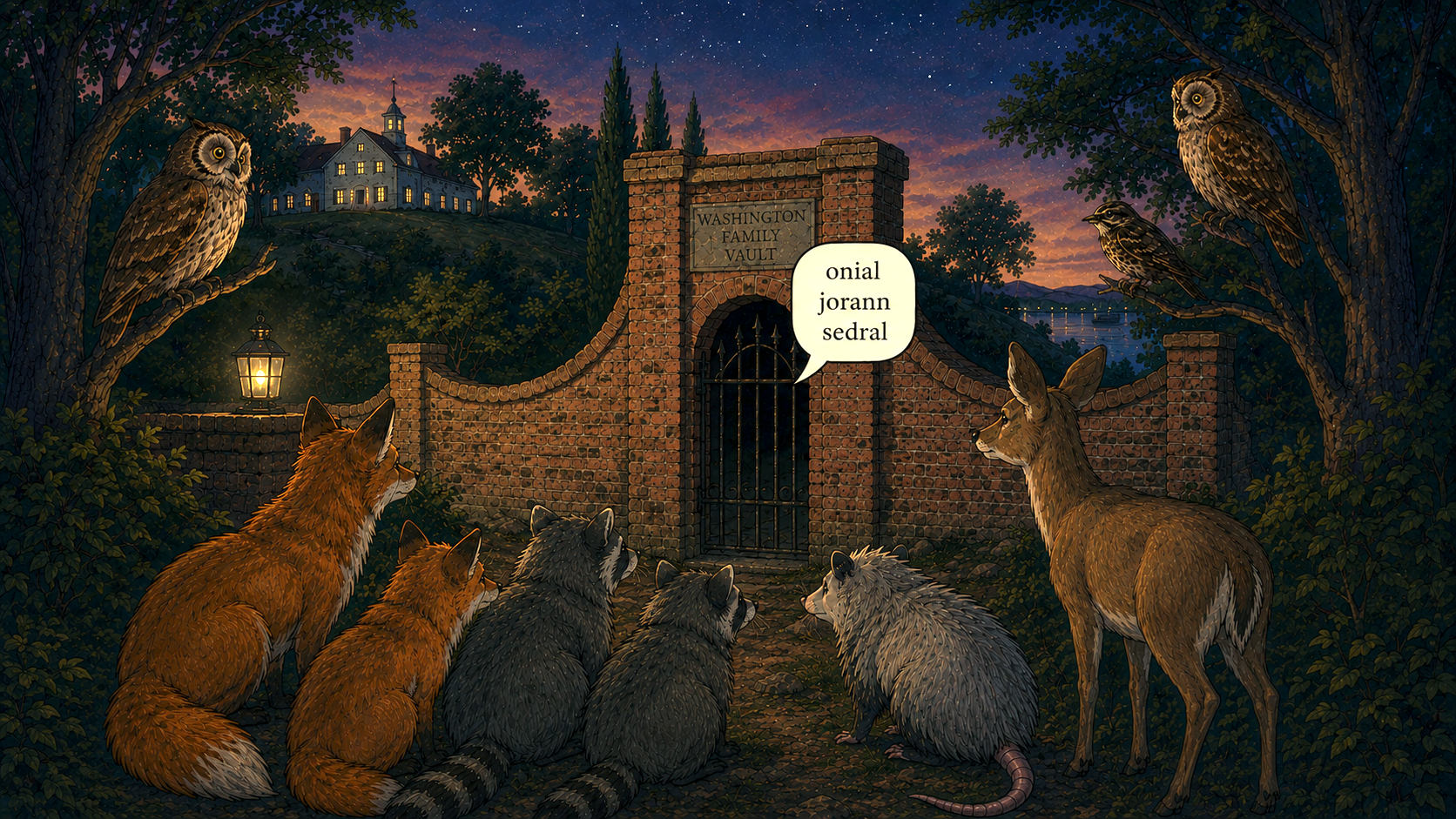
Once night and dead quiet have fallen on the place, long after the crowds of visitors have gone home and the staff have locked up and gone home themselves, the ones with the best hearing—the foxes and owls—gather round, to listen. They are struggling to make out what George Washington is uttering, while turning over, inside his carved, marble sarcophagus. Sounds like “onial,” “jorann,” “sedral,” and again, “onial,” “jorann,” “sedral.”
Washington doesn’t know that the thick stone walls of his final resting place, an upgrade gifted more than thirty years after his death to replace his original mahogany coffin, are muffling his words into incomprehensibility. Like the cries of a sleeper trapped in a nightmare, heard as slurred impressions, destined to be misinterpreted.
Looking back, it seems a wooden coffin would be more in keeping with Washington’s simple deathbed request to be “decently buried.” In addition to this pompless instruction, in his will he expressed his desire to remain at Mount Vernon, to be placed in the private family tomb, a simple structure that was eventually replaced by the current larger but still relatively humble brick tomb.
His wish to remain at Mount Vernon was not to everyone’s liking. Immediately following his death, the construction of a monumental crypt for Washington was worked into the design for the new, not-yet-completed Capital Building, with the plan of removing his remains there once completed. Located two stories below the Rotunda, the original plan featured a section of glass flooring allowing the public to view the crypt from above.
The plan to move Washington’s remains was never executed. All the better, I say. He was not forced to leave home and be an unwilling participant in institutionalized idol worship.
Washington understood the power of presentation, not just in the afterlife but throughout his life. For his inauguration as the nation’s first president, he chose to wear a suit of home-spun. He understood that no matter the wealth or prestige, restraint should always be exercised, to avoid overt references to kingly status and royal courts. To him, extravagance was simply un-American. It comes up as one of the reasons he argued tirelessly for the creation of national university, so that youth are not required to study abroad, where too often they acquire not only “habits of dissipation & extravagance, but principles unfriendly to Republican Government and to the true & genuine liberties of Mankind; . . .”
Washington’s comportment in adulthood is often traced back to a set of 110 rules of civility he copied down in a notebook at the age of about fourteen, probably as a penmanship exercise. These rules are thought to have greatly informed the man he would become. Many of the precepts emphasize modesty, humility, and discretion: There is one advising not to play the peacock; another to converse without malice or envy, being a sign of a commendable nature; a third, to not show yourself glad at the misfortune of another even if your enemy; a fourth, to avoid all forms of flattery.
When our current aggrandizing president:
- Hangs emperor-sized banners of himself from Federal buildings;
- Depicts himself as Jesus;
- Sprinkles self-congratulatory signs to himself throughout the Capital for publics works carried out by the National Park Service and paid for by tax-payer dollars;
- Rips down the East Wing, destroying the symmetrical balance of the White House and proposes a thing of dominating excess in its place: a glittering and outsized appendage cloaked in the visual motifs of our architectural history without regard for their principles.
He, too, understands the power of presentation.
And what of Washington’s muffled three-part message? Colonial, Georgian, Federal, when heard clearly. Words that conjure the built environment of the Founders, from their earliest memories to the nascent days the United States of America. (Ironically, had history made a king of George Washington, instead of the new nation’s first elected president, I suppose we would have had a continuation of the “Georgian” style rather than the Federal style that followed.)
The hallmarks of these architectural styles are symmetry, balance, and a simplicity that was extreme at the start, evolving eventually into a restrained elegance, reflecting the status of the builder. The Rockefellers understood and valued our heritage of beautiful simplicity, when they founded Colonial Williamsburg in 1926. One hundred years later, with the 250th anniversary of the signing of the Declaration of Independence approaching, shouldn’t the elected caretakers of our nation be returning—in form and spirit—to the architectural principles in vogue in 1776 rather than usurping them for imbalanced aims, such as a ballroom design that dwarfs the other main two parts of the White House. Because balanced design is surely a sign of a balanced government, with three balanced branches.
∼∼∼∼∼∼∼∼∼
Further Reading
Current tomb, marble sarcophagus, original wooden coffin, and crypt construction in Capital building:
https://www.mountvernon.org/the-estate-gardens/location/washington-tomb
https://www.youtube.com/watch?v=8fM7Es2–NEQ
https://www.aoc.gov/explore-capitol-campus/blog/how-capitol-crypt-got-its-name
https://americanhistory.si.edu/collections/object/nmah_1398256
Washington’s Deathbed request:
Request in Washington’s will regarding burial at Mount Vernon:
https://www.mountvernon.org/the-estate-gardens/location/washington-tomb
Home-spun suit worn for inauguration:
https://www.mountvernon.org/estate-gardens/historic-trades/recreating-washingtons-inaugural-suit
https://www.whitehousehistory.org/photos/president-george-washingtons-inaugural-coat
Rice, Donald Tunnicliff Rice (2021). Who Made George Washington’s Uniform: From Raising and Shearing the Sheep to Sewing the Final Stitches. Monographia Publishing.
Commentary in will about need to establish national university:
https://founders.archives.gov/documents/Washington/06-04-02-0404-0001
The rules of civility:
President Trump hangs banner of himself from federal bldg.:
https://www.nytimes.com/2026/02/19/us/politics/trump-banner-doj.html
President Trump depicts himself as Jesus:
https://www.nytimes.com/2026/04/13/us/politics/trump-jesus-picture-pope-leo.html
President Trump sprinkles thank-you signs to himself around D.C.:
https://www.washingtonpost.com/style/2026/05/07/signs-thanking-trump-in-washington/
President Trump’s ballroom design:
https://www.nytimes.com/interactive/2026/02/17/us/trump-white-house-east-wing-ballroom-design.html
Founding of Colonial Williamsburg:
https://www.williamsburgva.gov/488/History
https://www.rbf.org/about/our-history/timeline/colonial-williamsburg
On the visual used in this blog posting:
The animals and speech bubble are AI add-ons to an 1853 landscape painting by artist William Matthew Prior in the style of S.H. Brooke. The painting, found here, shows the tomb and house from a different perspective. The brick tomb of President George Washington is the central focus of the painting, while the Potomac is shown on the right-hand side of the painting and Mt. Vernon on the upper left, on the hill above the tomb. Prior was an American folk artist mostly known for portraits.
About the Writer
What am I doing posting an opinion piece that’s part allegorical satire, part cultural and political commentary on a blog devoted to food and cookbooks? Because it’s what I’ve got, publishing-wise. Like most everyone, I’ve got multiple interests and preoccupations. Before I’d found a way to pursue my biggest love at the top of an upside-down pyramid (food and cooking), I focused on the next runner up: arts and art history, receiving master’s degrees in both areas of study. Eventually I became an editor of art, art history, and architectural history books for various publishers, including Abrams, Watson-Guptill, Prentice Hall, UVA Press, and Monacelli. I even dabbled in writing about art, mostly for the now defunct art magazine Dialogue but other art publications as well.
On a personal level, my love of historic architecture goes much deeper, and can be traced directly to the impressionable years of my youth spent living in the historic town of Winchester, VA, There my late father, W. Raymond Jennings, became an early and influential president of Preservation of Historic Winchester, and the namesake of the Jennings Revolving Fund, which has done much good in helping to safe-guard the historical fabric of the town. I was greatly impacted and inspired by the historical architecture of Winchester and the surrounding area and by school-age visits made to Mount Vernon, Monticello, and Colonial Williamsburg. If I could dedicate a blog posting, I would dedicate this posting to my father, who loved all good design, whether industrial, furniture, household objects, or buildings.
 Loading ...

Holly,
1I’m delighted to see your attention has returned to architecture. Perhaps it never left. What a good piece of writing for this moment in the nation’s history.
Thank you David for your comment. Being an architect as you are, I know you appreciate the importance of design in culture. Discussion of design is too often relegated to specialists. Perhaps this essay is proof that it’s a subject for everyone!
2