
Making Feta Cheese at Home
Back in January, when DCCC was deep into Greek cooking, my boyfriend, Mike, who is always challenging me to think outside the box, and to take things one step further, suggested I make homemade feta cheese. Because of my zeal for exhaustive research, I sometimes wonder if he later regrets these, at the time, casually made suggestions. After having made four test batches, the refrigerator is full of multiple containers of feta marked “Test 1,” “Test 2,” and so on. If it weren’t for the fact that feta keeps a very long time in brine—up to a year—I would worry how just the two of us would be able consume so much of it. Now, after allowing all the batches of homemade feta cheese a full four weeks to cure in brine, I’m ready to report my findings to you.
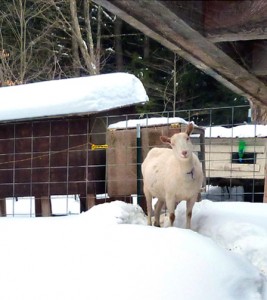
"Creamy," an Alpine-Saanen mix, owned by goat herder Martha Haffner. I love the quizzical look that goat's have.
Living in rural Vermont—a state known for cheese and dairy production—we have fairly easy access to farm fresh goat’s milk, so I made three batches with goat’s milk and one with cow’s milk. Sheep’s milk, the most traditional milk for making feta, is much harder to find where I live.
In addition to using two different milks, I tried two different cultures (sometimes called “starters”)—a basic mesophilic and a feta culture; lipase powder, a water-soluble enzyme added to milk to create stronger flavor in some cheeses; and calcium chloride, used to create a firmer curd.
All of the versions turned out—meaning, they all turned into cheese that looked, tasted, and behaved like feta, though some more than others. Ultimately, the decision of what culture to use, what milk, and whether to use lipase is one of personal taste. I’ll try to objectively describe my own preferences so that you can decide which version you might like to try first.
Like all types of agricultural products, cheesemaking is affected by the seasons. Though there are other variables, the single biggest impact on the flavor of cheese is the feed the animals are on, which is, in turn related to the time of year (dried grains in winter; fresh pasture in summer). According to Mary Jane Toth, author of Goats Produce Too!, lipase is more noticeable in milk during the winter months when goats stock are (more…)
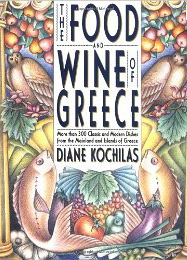 THE FOOD AND WINE OF GREECE
 This is what I found myself doing one Saturday last month, just as our guests Melanie and Matt were to arrive. If only the cookbook author had said to unroll the pinwheels of dough before placing them on the tray to dry. But, after all, it’s impossible to account for the strengths and weaknesses of every home cook. And this is how you learn, I thought, and become familiar with and eventually intuitive about a new cooking terrain. (The whole episode reminded me, appropriately enough, of a book my mother used to read to me when I was small called The Noodle-head Epaminondas. It is about a boy who followed directions to the letter, but didn’t have commonsense to apply them to the right context.)
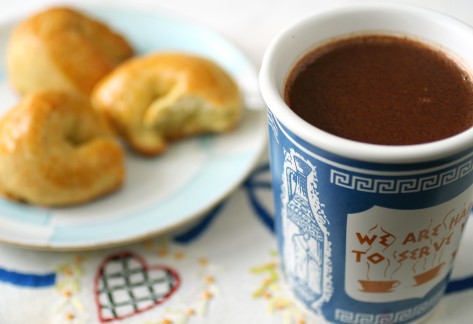 Greeks love honey, and are famous for the variety and quality their bees produce, chief among being wild thyme honey. I’m intrigued with honeys that capture the flavor of specific regional herbs, flowers or trees, and, though I’ve never tried thyme honey, I like to imagine how it might taste. With this special Greek honey in mind, this drinking chocolate is sweetened with honey and infused with the flavor of fresh thyme and orange zest—the latter, a common ingredient in Greek pastries, cakes, biscuits, and breads. While I’m not sure how Greek this drinking chocolate tastes, it does taste good. I enjoyed it with Olive Oil Biscuits with Cumin and Sesame, a common breakfast food in Greece, from the DCCC pick The Food and Wine of Greece.* (For lots more information on the basics of making and serving drinking chocolate, read
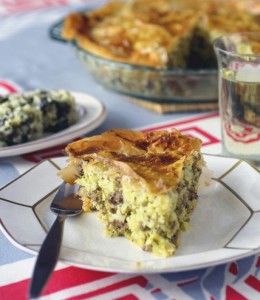
 This is Georgia Cone’s family recipe for
  Loading ...